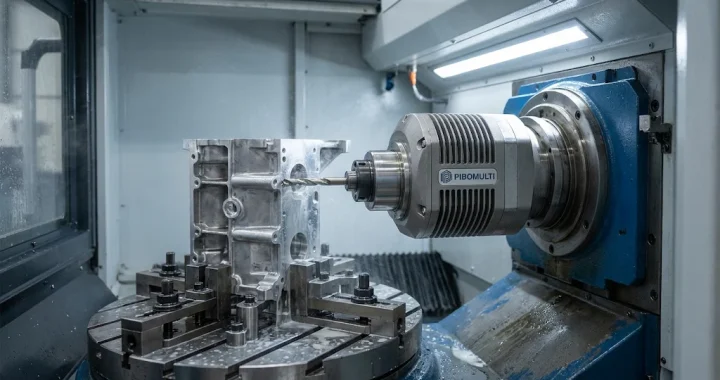
Sub-CNC Precision has added two Citizen machines, bringing its operating fleet to 21 at the end of 2025. The Luton subcontractor’s latest purchases are a Cincom L20-XLFV and a Miyano BNE-51MSY. The company has bought 25 Citizen machines over its history, exchanging some along the way. Its development illustrates a sustained investment strategy centred on bar fed, multi axis turning rather than a single recent equipment purchase.
The business began in 2008 and reports expected turnover of £3 million for its current financial year. It is ISO 9001 accredited and JOSCAR registered, according to the source. These details describe the company’s scale and operating credentials, but they do not independently establish the capability of every process. The more specific manufacturing story concerns the balance of sliding head and fixed head equipment and the management of unattended production.
Different turning platforms cover different work
Around two thirds of the fleet consists of Cincom sliding head machines producing parts from 0.5 to 38 millimetres in diameter. The remainder are Miyano fixed head turning centres. The source describes the latter processing bar from 8 to 65 millimetres and billets up to 200 millimetres. These are reported operating ranges across the fleet, rather than capacities that should be assumed for every individual machine.
That mix allows a subcontractor to route work according to geometry and production needs. Small slender components can present different support and handling problems from larger fixed head work. Choosing the machine should therefore follow the part and its process requirements. A common supplier relationship may simplify aspects of support, but it does not make the two machine types interchangeable.
Twin spindle and multi axis capability can also support completed parts with fewer transfers where the feature arrangement permits it. The useful outcome is a reliable route that maintains relationships between features and handles the component predictably. A production assessment needs to include tool access, workpiece transfer and inspection rather than assuming that additional axes automatically reduce the total effort.
Chip control supports unattended time
Many of Sub-CNC’s machines operate without attendance from 18:00 to 07:00, according to the report. Citizen’s low frequency vibration chip breaking software, introduced to the company’s Cincom operations in 2017, is identified as an important enabler. LFV can be switched through programme commands and has different modes for adjusting chip size. It can therefore be applied to selected parts of a cycle rather than used continuously.
That selectivity matters because chip control requirements vary through a component. A troublesome turning region may benefit from additional intervention, while another operation may already produce manageable chips. Programming the function where needed allows the process planner to target the difficult stage. The source does not provide a universal parameter set or a numerical reliability improvement attributable to LFV alone.
Unattended machining also depends on more than chip breaking. Bar supply, tool condition, part collection and the response to interruptions all affect how long a machine can operate productively. These are general planning considerations, not shortcomings reported at Sub-CNC. A successful night shift is measured in acceptable parts available the following morning, rather than hours during which the machine was merely enabled.
The latest additions continue a long term capacity strategy built around repeatable turning and suitable automation. For designers using subcontract machining, the case is a reminder that productive manufacture depends on matching geometry to the available route. Discussing bar size, feature access and inspection requirements early can help a supplier exploit its equipment effectively while maintaining the quality expected from a controlled production process.
Source — mtimagazine.com. Source publication date 2026-01-23. Engineering analysis: The CAD Verse.