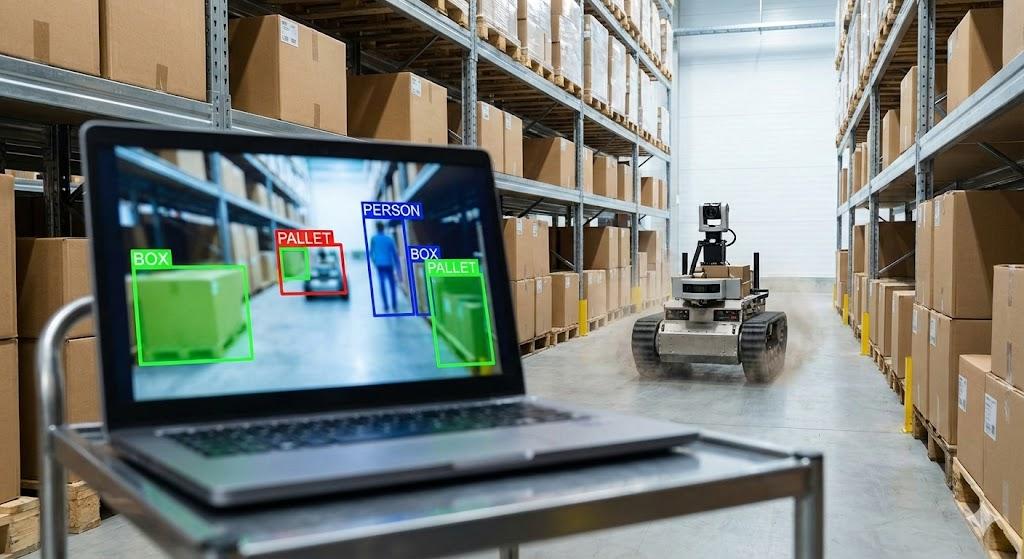
Industrial robots increasingly operate in environments where they must identify objects, remember their locations and perform tasks involving multiple steps.
However, a robot’s perception system can make mistakes. Poor lighting, partial visibility, distant objects or blurred camera images may cause a robot to store an incorrect description of an object. If that information remains in its internal map, the error can affect later decisions.
Researchers at MIT have developed a system called UQ-DAAAM, short for Uncertainty Quantification for Describe Anything, Anywhere, at Any Moment.
The method builds on an earlier robot memory framework that uses vision-language models to describe objects and store those descriptions in a map of the environment.
UQ-DAAAM adds an uncertainty measurement process. It compares descriptions of the same object captured from different viewpoints, evaluates how consistent those descriptions are and identifies entries that may be unreliable.
When uncertainty is too high, the system selects additional camera views and combines the new information to refine the stored description.
The researchers report that the approach resolved ambiguities for approximately 92% of the evaluated objects while requiring only two additional captions per object. It also improved object-description accuracy by 5% compared with the reported baseline.
Why this matters for industrial automation
Reliable perception is essential when robots work alongside people, handle components or perform complex assembly tasks.
A robot that cannot recognise when its own information may be wrong can repeat the same mistake throughout an operation.
The MIT research addresses this problem by making uncertainty part of the robot’s memory process. Instead of treating every visual description as equally reliable, the system can identify questionable information and actively seek better evidence.
This is particularly relevant to flexible manufacturing environments, where object positions, workpieces and surrounding conditions may change.
The system remains a research development, but it highlights a key requirement for physical AI: robots must not only perceive their surroundings; they must also assess the reliability of what they perceive.