The mechanical performance of composite materials is usually controlled through the selection of matrix materials, reinforcement fibres, particle composition and manufacturing parameters. A new research direction suggests that the geometry of individual filler particles can become another important design variable.
Researchers at Tampere University have investigated architected fillers: small particles whose three-dimensional shapes are deliberately designed and manufactured rather than determined by conventional synthesis or milling processes.
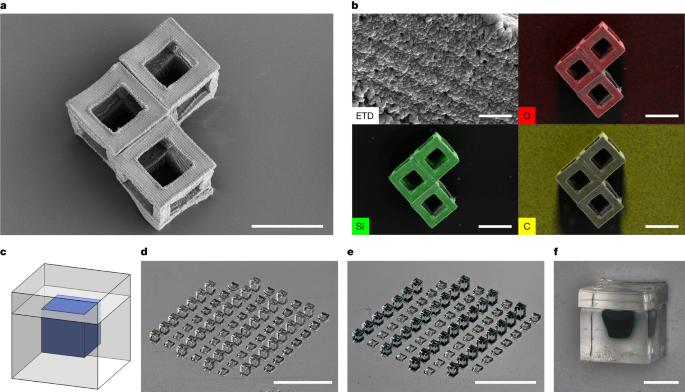
Using high-resolution Digital Light Processing (DLP), the research team produced sub-millimetre polymer particles in different geometries, including cubes and four-armed tetrapods. These particles were then embedded in silicone matrices to evaluate their mechanical response under compression.
The results showed that particle geometry had a substantial influence on composite stiffness. Tetrapod-shaped fillers increased the stiffness of the silicone composite by up to 12.8 times compared with unfilled silicone and outperformed cubes of matching size on a filler-normalised basis.
Interestingly, the largest cube-shaped fillers demonstrated a reproducible stress plateau under compression, a behaviour not observed with the other tested geometries.
Engineering implications
The research introduces a new way of designing composite materials. Instead of changing the chemical formulation, engineers may be able to tune stiffness and deformation behaviour by changing the geometry of the reinforcement particles.
Potential applications include soft robotics, biomedical devices, tissue-engineering scaffolds and flexible mechanical components.
Further investigation is required to assess long-term durability, fatigue behaviour, manufacturing scalability and performance under different loading conditions. Nevertheless, the study demonstrates that particle geometry can be engineered as deliberately as the matrix material itself.