Predicting how materials behave under complex loading conditions is a fundamental requirement in computational mechanics.
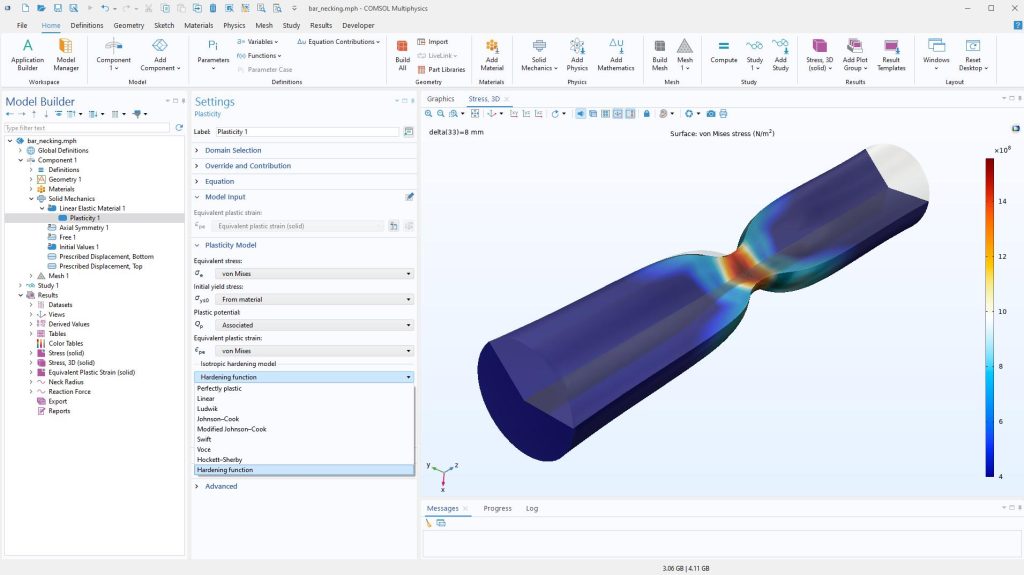
Traditional finite element analysis relies on constitutive material models to describe relationships between stress, strain and deformation. These models are often based on assumptions about elastic behaviour, plastic yielding and hardening mechanisms.
Data-driven computational mechanics offers an alternative by using experimentally or numerically generated material-state datasets. However, extending these approaches to plasticity is challenging because material response depends on loading history.
Researchers have introduced a hybrid model-data framework designed to address this limitation.
The method combines discrete material-state datasets with constitutive assumptions for kinematic and isotropic hardening. It also incorporates Prager’s law for back-stress evolution without explicitly prescribing its complete functional form.
The framework retains standard computational plasticity procedures while performing key calculations, including return mapping and search-direction determination, through data spaces.
Numerical examples involving both one-dimensional and three-dimensional problems were used to demonstrate the approach.
Implications for FEA and CAE
The study represents an important development in the relationship between physics-based simulation and data-driven modelling.
Rather than replacing established computational mechanics algorithms entirely, the hybrid method integrates material data into the numerical framework.
This could offer engineers additional flexibility when modelling complex plastic deformation, particularly where conventional constitutive assumptions are insufficient.
Further investigation is needed to assess computational efficiency, dataset requirements, convergence behaviour and performance for industrial-scale finite element models.
For CAE professionals, the work illustrates a possible direction for next-generation material modelling: combining the reliability of established mechanics with the flexibility of data-driven approaches.