Introduction
Noise, Vibration, and Harshness (NVH) engineering plays a critical role in automotive development, industrial machinery, electric powertrains, and mechanical system integration. As products become more complex, engineers must characterize individual components accurately before integrating them into larger assemblies.
Siemens has introduced an automated component model extraction solution designed to simplify this process and accelerate virtual NVH development.
Automating Component Characterization
Developed in collaboration with Bosch, the solution combines automated test benches, specialized measurement hardware, and Simcenter software.
The system automates blocked force extraction in accordance with ISO 20270, enabling engineers to generate repeatable component models for system-level NVH prediction.
Traditional component characterization can require extensive manual measurements and specialist knowledge. The new workflow reduces operator dependency by integrating measurement and data processing into a controlled process.
Up to 93% Reduction in Measurement Time
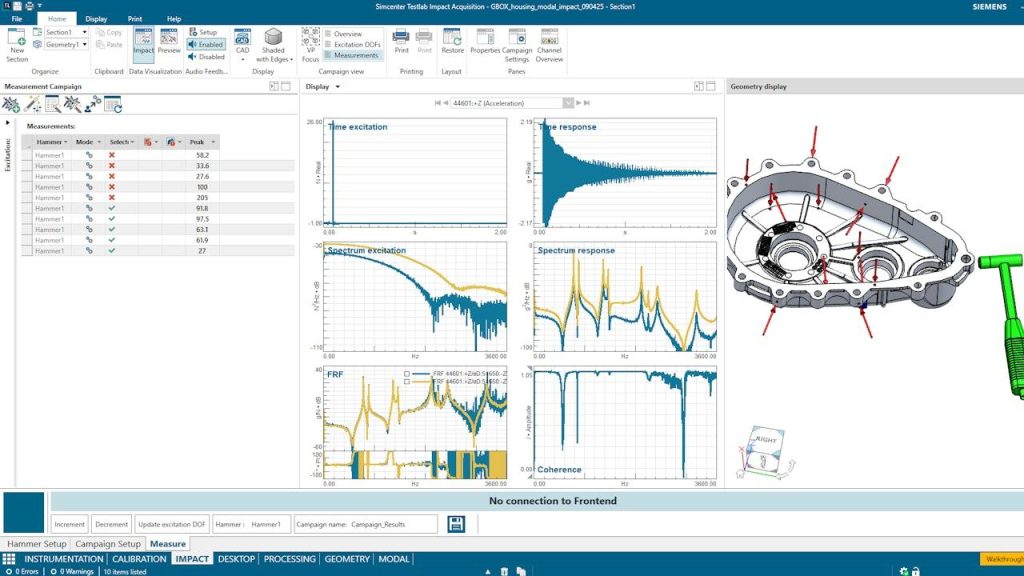
According to Siemens, the solution can reduce Frequency Response Function (FRF) measurement time by up to 93% compared with conventional methods.
The system uses a self-measuring fixture equipped with shakers, accelerometers, virtual-point adapters, and automated measurement electronics.
An important characteristic is that instrumentation remains attached to the fixture rather than being repeatedly installed on each test component. This simplifies component replacement and supports repeatable batch testing.
Applications in Automotive and Industrial Engineering
The technology can support the characterization of:
- Electric motors
- Pumps and compressors
- Steering systems
- Actuators
- Other mechanical components requiring NVH integration
The resulting models can be incorporated into CAE-based virtual prototypes and digital twin workflows.
Engineering Implications
Automated NVH characterization can improve the consistency of component data used during system integration.
For automotive engineers, this is particularly relevant to electric vehicle development, where motor noise, structural vibration, and transmission paths influence perceived vehicle quality.
The technology also demonstrates how physical testing and virtual engineering are becoming increasingly interconnected.
Conclusion
Siemens’ automated component model extraction solution represents a practical step toward more repeatable and efficient NVH engineering.
By reducing measurement time and standardizing component characterization, the technology can help engineering teams make earlier decisions and reduce dependence on repeated physical prototype testing.
Source: Siemens and Engineering.com.