How NAFEMS and Rescale Are Working to Establish Independent Standards for AI in CAE
Introduction
Artificial intelligence is rapidly entering engineering simulation. AI-based surrogate models can approximate computationally expensive simulations, support design exploration, and help engineers investigate more alternatives in less time.
However, a critical question remains: How can engineers know whether an AI model is accurate and reliable enough for real engineering decisions?
A model may perform well on the data used during its development but produce unreliable results when applied to a different geometry, operating condition, or physical problem. In engineering, this is not simply a software performance issue. An inaccurate prediction can influence structural integrity, aerodynamic performance, thermal management, and product safety.
To address this challenge, NAFEMS and Rescale introduced AIPhysics.org on October 28, 2026. The initiative aims to establish an open and independent benchmarking environment for evaluating AI methods used in engineering modelling, analysis, and simulation.
1. Why Does AI in Engineering Need Independent Benchmarking?
Traditional engineering simulation relies on numerical methods such as finite element analysis (FEA), computational fluid dynamics (CFD), and crash simulation.
These methods can provide detailed insights into physical behavior, but high-fidelity simulations often require significant computing resources and processing time.
AI-based surrogate models offer an alternative approach. Instead of solving every physical problem from the beginning, a trained model can estimate results based on patterns learned from existing simulation data.
This can accelerate certain engineering workflows, particularly during:
- Early-stage product design.
- Parametric design exploration.
- Optimization studies.
- Preliminary performance evaluation.
- Repeated simulation scenarios.
Nevertheless, faster predictions do not automatically mean more reliable engineering results.
Different AI models may use different training datasets, evaluation methods, and accuracy measurements. Without a shared benchmark, comparing their real engineering performance becomes difficult.
AIPhysics.org is designed to address this gap.
2. What Is AIPhysics.org?
AIPhysics.org is an open benchmarking initiative introduced by NAFEMS, the International Association for the Engineering Modelling, Analysis and Simulation Community, in partnership with Rescale.
The initiative aims to bring together engineering software developers, AI researchers, universities, industrial engineering teams, and technology providers.
Its main objective is to create a common framework for evaluating AI models against real engineering problems.
NAFEMS is responsible for independent governance and the development of benchmarking methodology, while Rescale provides technical infrastructure, AI frameworks, cloud computing resources, and support for model submissions and evaluations.
An important principle is that the initiative is intended to remain open to the wider engineering community, including software providers that compete with Rescale.
3. How Will the Benchmarking Process Work?
AIPhysics.org is designed around three central elements.
Public Training Data
Participants will have access to public datasets representing real engineering problems.
These datasets can be used to train AI models using different architectures, algorithms, and development approaches.
The objective is to allow researchers and engineering teams to work with comparable reference problems.
Blind Evaluation
One of the most important elements is the use of private test cases.
A model will be evaluated using test data that is not publicly available for training. This helps reduce the risk of a model being specifically adjusted to reproduce known benchmark answers.
In practical terms, a model must demonstrate how well it performs on previously unseen cases rather than simply memorizing familiar examples.
Published Results and Methodology
The initiative aims to publish evaluation results and explain how they were obtained.
This transparency is essential because an engineering benchmark should not only provide a score. It should also make the evaluation process understandable and reproducible.
The methodology, data sources, and changes to evaluation procedures are intended to be documented publicly.
4. Five Initial Engineering Benchmark Problems
The initial benchmark set covers five problems across structural mechanics, fluid dynamics, aerodynamics, and crash simulation.
Plate with Hole
A classic structural mechanics problem used to investigate stress distribution around a geometric discontinuity. It provides a useful reference for evaluating how AI models predict stress-related behavior.
2D Airfoil
This benchmark focuses on airflow around a two-dimensional airfoil. It is relevant to aerodynamic prediction and the ability of AI models to represent flow behavior.
DrivAerML
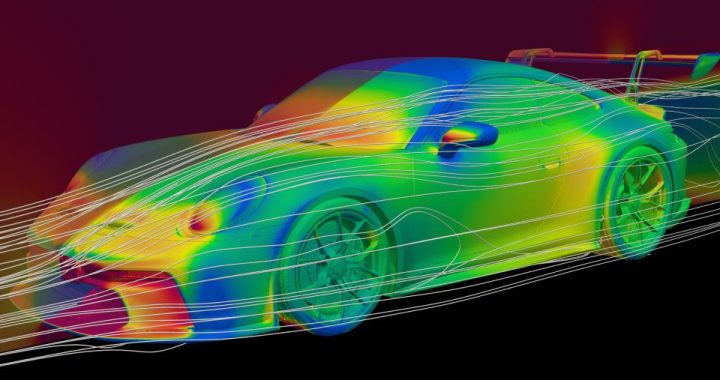
DrivAerML is a vehicle aerodynamics dataset associated with external airflow around a road-car geometry. It provides a more complex automotive application for evaluating AI-based aerodynamic predictions.
HiLiftAeroML
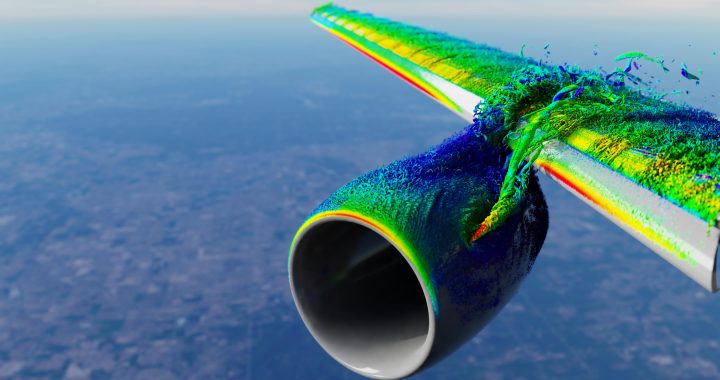
This benchmark addresses high-lift aircraft aerodynamics, an important area in the analysis of aircraft configurations operating at demanding lift conditions.
OpenRadioss Frontal Crash Model
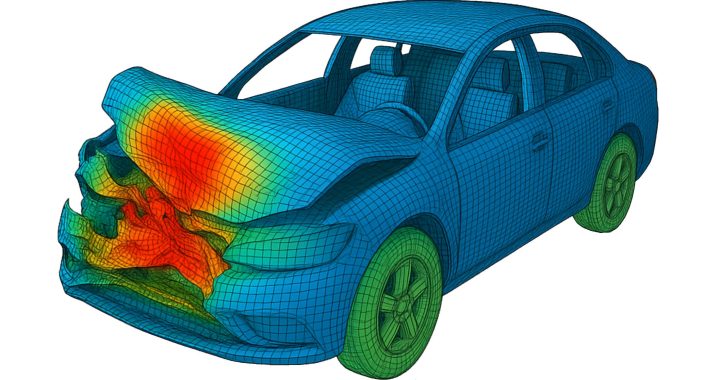
The fifth benchmark involves a frontal crash simulation model using OpenRadioss. It introduces a highly dynamic engineering problem in which structural deformation and impact behavior must be evaluated.
Together, these five problems provide an initial basis for assessing AI methods across different physical domains.
5. Why Does This Matter for FEA and CFD Software?
AI-assisted simulation is becoming increasingly relevant to established CAE software ecosystems.
In FEA, AI models may help estimate structural responses, identify important design parameters, or accelerate repeated evaluations.
In CFD, surrogate models can support aerodynamic exploration, flow prediction, and optimization studies.
In crash simulation, AI methods may help explore design alternatives and approximate selected response characteristics.
However, the usefulness of these methods depends on more than prediction speed.
Engineers need to understand whether a model can reproduce important physical quantities, how it behaves outside its training conditions, and where its predictions become unreliable.
An independent benchmark can help make these limitations more visible.
6. What AIPhysics.org Does Not Mean
The launch of AIPhysics.org should not be interpreted as proof that AI models are already ready to replace conventional engineering solvers.
The initiative is a benchmarking framework, not a new FEA or CFD solver.
It does not eliminate the need for mesh generation, boundary conditions, material models, numerical validation, or engineering review.
Likewise, a strong benchmark result in one physical problem does not automatically establish reliability in every other application.
AI models must still be evaluated against the specific physics, geometry, operating conditions, and engineering requirements of each use case.
7. The Future of AI Validation in Engineering
The development of AI in engineering is moving beyond demonstrations and isolated performance claims.
As these technologies enter industrial design and simulation workflows, the ability to evaluate their accuracy, robustness, and limitations becomes increasingly important.
AIPhysics.org represents an attempt to establish a shared reference point for this process.
If the initiative succeeds in attracting broad participation, it could help engineers compare AI methods using common datasets and transparent evaluation procedures.
That would be an important step toward more responsible adoption of AI in engineering simulation.
Conclusion
AI has the potential to transform how engineers perform simulation, explore design alternatives, and optimize products.
But engineering decisions require more than fast predictions. They require confidence in the results.
By combining NAFEMS’ independent engineering community with Rescale’s technical infrastructure, AIPhysics.org aims to create a common benchmarking environment for AI-powered simulation.
Its five initial benchmark problems provide a starting point for evaluating AI across structural, aerodynamic, fluid, and crash-related applications.
The next major step for AI in CAE may not be simply making simulations faster. It may be proving when AI-generated engineering results can be trusted.
References