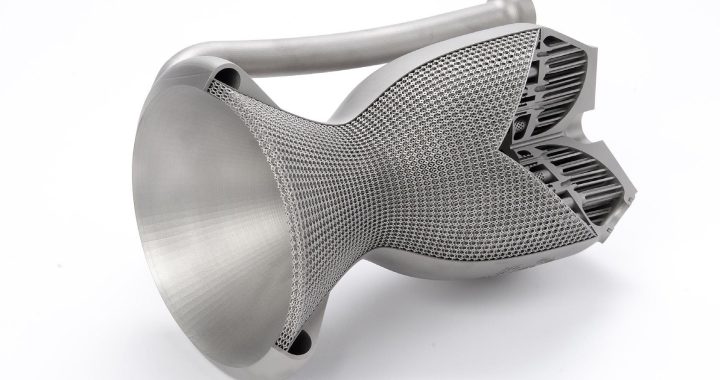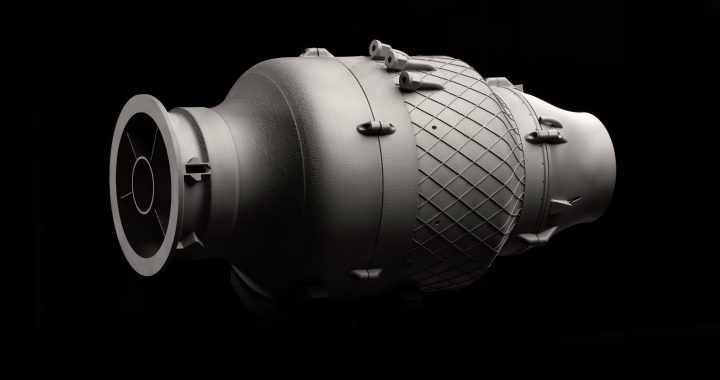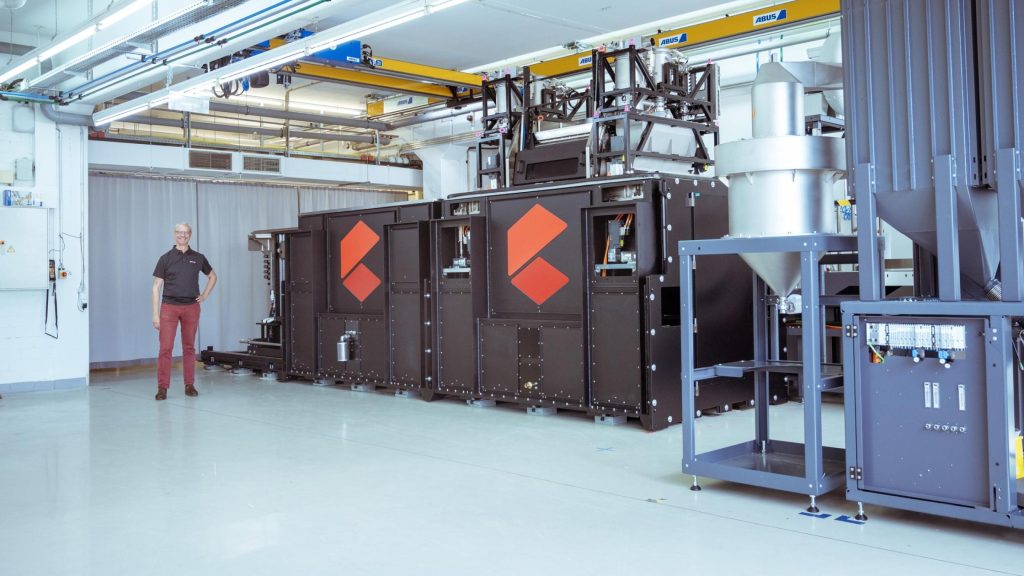
The development of hypersonic vehicles requires advanced materials, complex geometries and manufacturing processes capable of producing large, high-performance components. Kratos Defense & Security Solutions has expanded its manufacturing capabilities through the acquisition of an AMCM M 8K large-format metal additive manufacturing system from EOS.
The system is planned for installation at Kratos’ Indiana Payload Integration Facility in Odon, Indiana.
Large-Format Metal Additive Manufacturing
The AMCM M 8K is designed for demanding aerospace and defense applications. According to EOS, the machine offers a build volume of 800 × 800 × 1,200 mm and is equipped with eight 1.2 kW lasers.
The large build envelope is intended to support the production of substantial metal components while multiple laser sources help address the demands of large-area powder bed fusion manufacturing.
The platform also incorporates thermal management, process-gas flow systems, filtration and in-process monitoring technologies.
Why Scale Matters in Hypersonic Development
Hypersonic systems operate under extreme thermal and mechanical conditions. Their development can involve complex structures, high-performance materials and strict requirements for dimensional consistency.
Large-format additive manufacturing can support the production of geometries that may be difficult or expensive to create through conventional machining and fabrication. It can also reduce the need to assemble multiple smaller components, depending on design and qualification constraints.
From Development Capacity to Production Readiness
Kratos’ investment reflects growing interest in domestic advanced manufacturing capacity for defense and aerospace applications.
The acquisition does not by itself establish that every future hypersonic component will be produced on the system. Material qualification, process validation, inspection and application-specific testing remain essential.
Nevertheless, the installation represents a significant investment in large-format metal additive manufacturing and demonstrates the expanding role of industrial 3D printing in advanced aerospace production.