Producing large metal components through additive manufacturing offers significant advantages in material efficiency and production flexibility. However, maintaining dimensional accuracy remains a major challenge, particularly when thin-walled structures are manufactured through arc-based deposition processes.
A recent study investigates dimensional instability in aluminium alloy components produced using droplet-and-arc additive manufacturing.
The research focuses on two important process challenges: the initial positioning of deposited material and the accumulation of heat during layer-by-layer manufacturing.
The researchers developed a mathematical model to predict molten droplet flight distance. This model was used to compensate for initial deposition-position errors and improve the accuracy of the first deposited layer.
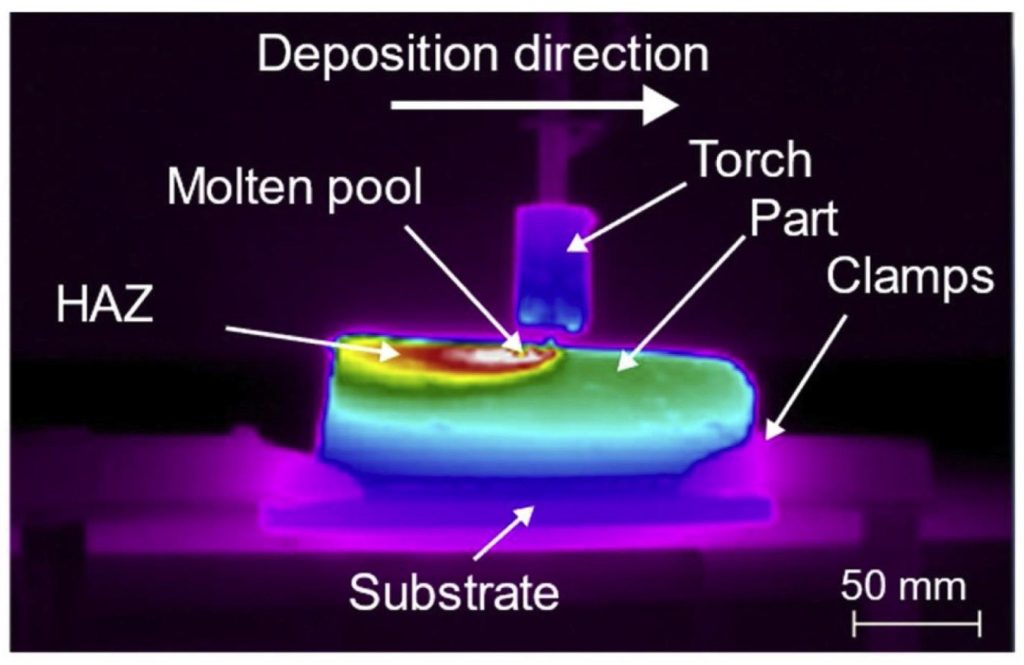
The team also analysed thermal accumulation during multi-layer deposition. Temperature measurements between layers were combined with process parameters to establish an energy-balance relationship.
A secondary deposition experiment on a ten-layer thin-walled component was used to investigate the relationship between arc energy density and deposited layer dimensions.
The results highlight the importance of controlling heat input and material delivery to maintain consistent geometry.
Why it matters for manufacturing
Dimensional instability can lead to excessive machining allowances, material waste and difficulties during assembly.
The research is particularly relevant to medium and large aluminium components used in automotive and aerospace manufacturing.
By combining droplet trajectory prediction, temperature monitoring and energy-input control, engineers can move towards more predictable deposition processes.
The findings provide a process-control foundation, although further validation across different aluminium alloys, geometries and production conditions will be necessary before industrial generalisation.