How Intelligent Mesh Adaptation Is Improving Turbulence Simulation
Computational Fluid Dynamics (CFD) is one of the most important tools in modern engineering. It allows engineers to investigate fluid flow, heat transfer, turbulence and aerodynamic behaviour before building physical prototypes.
However, detailed CFD simulations can require enormous computational resources. One of the main challenges is deciding where the computational mesh needs to be sufficiently fine to capture important flow structures.
Recent research into adaptive mesh refinement is exploring ways to make this process more efficient by allowing the mesh to change according to the behaviour of the simulated flow.
Why Mesh Resolution Matters
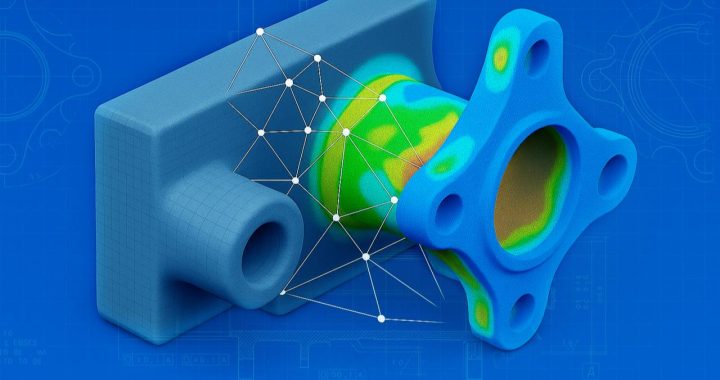
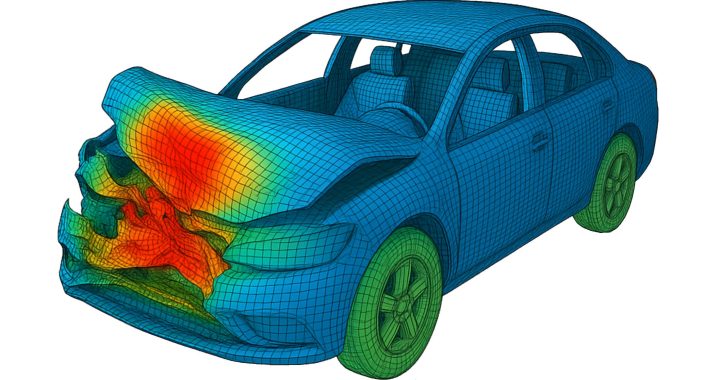
In CFD, the computational domain is divided into smaller cells or elements. The governing equations are solved across this discretised domain to estimate the behaviour of the fluid.
A fine mesh can capture smaller flow structures and steep gradients more accurately. However, increasing the number of cells also increases memory requirements and computational time.
Using an extremely fine mesh across the entire domain may therefore be inefficient.
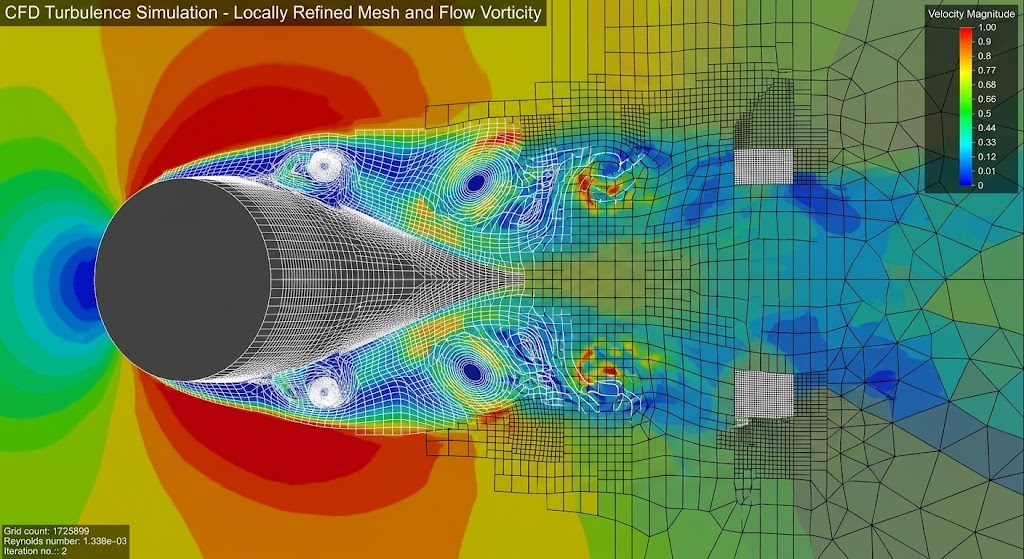
In many simulations, important flow features are concentrated in specific regions, such as:
- Shear layers
- Vortices
- Boundary layers
- Shock waves
- Mixing regions
- Areas with strong velocity fluctuations
Adaptive mesh refinement (AMR) addresses this challenge by increasing resolution where it is needed and reducing it in less demanding regions.
A Dynamic Approach to Turbulence Simulation
Research published in Advances in Aerodynamics in July 2026 investigated an adaptive large-eddy simulation (LES) framework based on local velocity fluctuation intensity.
The proposed approach uses information about local flow variations to determine where the mesh should be refined or coarsened.
Instead of maintaining the same resolution everywhere, the computational grid can respond to the evolving flow field.
The researchers also introduced adaptive subgrid models designed to estimate the influence of turbulent structures that remain smaller than the finest resolved mesh.
This is important because LES does not directly resolve every turbulent scale. Smaller unresolved structures are represented through a subgrid-scale model.
The study evaluated the approach using benchmark turbulent-flow problems, including Kelvin-Helmholtz instability, Taylor-Green vortex flow and a temporal mixing layer.
The authors reported improved computational efficiency while maintaining agreement with reference results for the investigated cases.
Space-Time Adaptation: An Additional Development
Another research direction combines spatial mesh refinement with local time stepping.
A study published in Advances in Aerodynamics in August 2026 introduced a gas-kinetic scheme with space-time adaptive mesh refinement, known as STAMR-GKS.
In this approach, different mesh regions can use different time steps according to their refinement levels.
Fine cells can advance using smaller time increments, while coarser regions use larger steps.
This can reduce the computational burden associated with advancing the entire mesh using the smallest time step required by the most refined region.
The method was evaluated using several flow problems, including cavity flows and shock-wave interactions.
Why Adaptive Mesh Refinement Matters to Engineers
Adaptive meshing can provide several potential advantages:
- More efficient use of computational resources
- Better resolution of important flow structures
- Reduced unnecessary mesh density
- Improved simulation workflows for complex geometries
- Potentially shorter simulation times
However, adaptive mesh refinement is not a universal solution to CFD performance challenges.
The results depend on refinement criteria, numerical methods, turbulence models, mesh quality, parallel computing efficiency and the physics being simulated.
A mesh that is too coarse can still miss important flow behaviour, while excessive refinement can reduce the expected performance benefits.
The Future of CFD Computing
As engineering simulations become more complex, the ability to allocate computational resources intelligently will become increasingly important.
Adaptive mesh refinement represents one approach to making CFD simulations more efficient without relying exclusively on larger computing systems.
Combined with GPU acceleration, parallel processing and improved turbulence models, adaptive simulation methods could help engineers investigate increasingly complex fluid-flow problems.
The objective is not simply to reduce the number of mesh cells. It is to place computational effort where it contributes most to understanding the physics of the problem.
Research sources:
Xu, C., Cai, J. & Pan, S., Adaptive large-eddy simulations with a dynamic subgrid model based on local velocity fluctuation intensities, Advances in Aerodynamics, July 2026.
Liu, G., Xing, Z. & Li, Q., Gas-kinetic scheme with space-time adaptive mesh refinement, Advances in Aerodynamics, August 2026.